
The future of search is no longer just about rankingin the top 5 of Google’s first page. With AI Overviews now live across multiple countries and languages, visibility increasingly depends on being cited in AI-generated overviews, not just being indexed.
For SEO leads and content strategists, the question heading into 2026 is simple:
”How do we earn AI citations without sacrificing traffic or brand trust?”
We decided to break down how AI Overviews work, why they matter and the on-page patterns that consistently win citations.
Table of Contents
- What Are Google AI Overviews?
- Why AI Overviews Matter Now…and Even More in 2026
- How AI Overview Citations Are Selected
- Page Patterns That Win AI Overview Citations
- Entity Coverage and Topical Depth Still Matter
- Editorial Standards and Brand Safety
- Measuring AI Overview Performance (What to Track)
- Quick Wins to Try This Month
What Are Google AI Overviews?
Google AI Overviews are AI-generated summaries that appear at the top of selected search results, designed to answer complex queries in an easily digestible format.
Key features include:
- Instant answers that reduce the need to click through multiple pages
- Visible citations that attribute information to authoritative websites
- Multi-source summarisation
- Top SERP placement, often above traditional organic listings
- Coexistence with classic results, allowing users to continue deeper research
- Support for complex and exploratory queries, not just simple fact lookups
AI Overviews tend to trigger when Google determines that a query cannot be answered well enough by a single webpage or a simple featured snippet.
In practice, this means AI Overviews are most likely to appear when:
- The query requires synthesis, such as combining definitions, steps, or viewpoints from multiple sources
- User intent is exploratory, indicating the searcher is learning rather than looking for a single fact
- The answer depends on context or trade-offs, for example, comparisons, pros and cons, or conditional advice
- Multiple sub-questions are implied, even if the user only types one short query
- Traditional snippets risk oversimplifying the answer, especially for nuanced or strategic topics
For SEO teams, this changes the optimisation goal. Rather than chasing a single “perfect” snippet, success depends on structuring content so it shows clear, trustworthy communication that Google feels confident citing.
Why AI Overviews Matter Now…and Even More in 2026
Google first launched AI Overviews widely in the US in May 2024, with rapid international expansion throughout 2025. Over that period, Google refined when overviews appear, improved citation quality and integrated them deeper with AI Mode and Deep Search.
By 2026, AI Overviews are now a staple part of search behaviour, particularly for complex, exploratory, and long-form queries.
Two changes from 2025 are especially relevant for SEO teams and Marketing Managers:
- More selective triggering, with AI Overviews appearing less frequently on simple queries and more consistently on nuanced or multi-step searches
- Greater emphasis on citation quality, with Google favouring clearly structured, authoritative pages over loosely relevant content
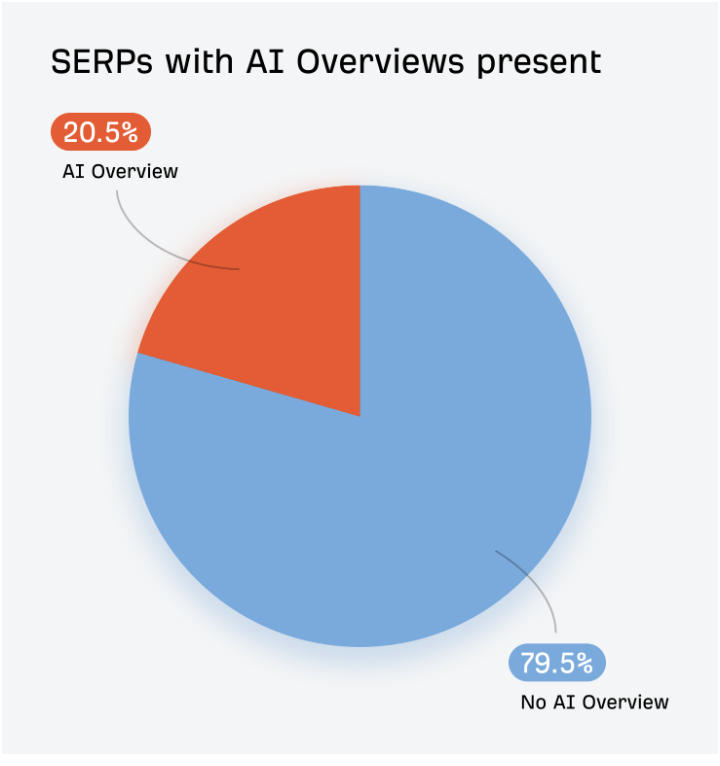
Semrush’s tracking across 2025 suggests AI Overviews settled at around ~16% of queries overall, with a much higher presence on specific informational query types.
This shift means visibility in AI Overviews is now a core SEO KPI and pages that explain topics clearly and comprehensively increasingly outperform pages that merely rank well on Google’s SERP.
How AI Overview Citations Are Selected
AI Overviews tend to cite pages that already demonstrate strong organic relevance and make it easy for Google to extract a trustworthy answer.
Google’s public guidance on AI Overviews is intentionally high-level. However, when you combine that guidance with independent research and observed SERP behaviour, a consistent pattern emerges.
Pages most likely to be cited typically:
- Rank within the top 10 organic results
- Answer the query directly and early, reducing ambiguity in interpretation
- Present information clearly, with minimal filler and strong topical focus
- Closely align with the intent behind the search, not just the keywords used
Google’s guidance via Google for Developers consistently emphasises creating helpful, distinctive content, rather than attempting to optimise specifically for AI systems.
Independent studies reinforce this approach. Ahrefs found 76.10% of AI Overview-cited pages also rank in Google’s top 10, which confirms that citations largely build on traditional ranking signals.
Ahrefs study of 1.9 million AI Overview citations: 76.1% cite pages ranking in the top 10 (9.5% rank 11–100, 14.4% outside top 100). Source: Ahrefs.
The implication for SEO teams is clear: earning citations is less about new tactics and more about structuring high-quality content. In other words, AI Overviews largely amplify strong SEO foundations, rather than replace them.
Page Patterns That Win AI Overview Citations
While AI Overviews draw from authoritative pages, citation selection is heavily influenced by how information is structured. Pages that surface clear answers quickly and reduce interpretation effort are far more likely to be used as sources. So how do we turn strategy into execution?
Lead With a Clear, Citable Answer
- AI Overviews prioritise pages that resolve the core question immediately. Strong citation candidates open with a direct, self-contained answer that:
- Responds to the primary query in one or two sentences
- Uses precise, neutral language that can stand alone
- Avoids brand messaging, opinion, or unnecessary context
A useful test is to ask: If this paragraph were lifted into an AI Overview without changes, would it still make sense on its own?
Use Subheadings That Mirror Question Variants
AI Overviews break queries down into smaller, implicit sub-questions. Pages that mirror this structure make it easier for Google to extract relevant sections.
Effective subheadings include:
- How users naturally phrase longer questions
- The topic clearly rather than creatively
- Signal comprehensive coverage of the subject
Package Facts for Scanning
AI systems favour content that can be interpreted quickly and confidently.
Pages that win citations often:
- Present facts in short, scannable lists
- Use small tables to compare options or outcomes
- Pair definitions with supporting evidence or examples
Linking to primary sources where possible reinforces credibility and reduces uncertainty around accuracy, a key factor in citation selection.
Use Schema Markup Carefully and Legitimately
Structured data can help Google interpret and classify your content, but it will not replace clear structure, strong sourcing, or genuinely helpful answers.
Use markup you genuinely qualify for, and ensure it matches what users can see on the page. Overuse, duplication, or marking up content that is not visible is often ignored and can weaken trust.
It’s important to be realistic about impact. FAQ rich results are now mostly limited to authoritative government and health sites, and HowTo rich results are deprecated, so treat these formats as UX improvements first, not as a shortcut to AI visibility.
Where appropriate, use schema you genuinely qualify for, such as:
- Organization or LocalBusiness
- BreadcrumbList
- Article (for editorial content)
- Service (for service pages)
- Product (where applicable)
- QAPage (only for genuine Q and A pages)
If you still use FAQPage markup, do it because the FAQ content helps users and improves clarity, not because you expect expanded SERP features.
Entity Coverage and Topical Depth Still Matter
AI Overviews reward topic mastery, not isolated pages. Cross-industry studies show a small set of “reference platforms” (notably Reddit, Wikipedia and YouTube) appear disproportionately often in AI citations, which raises the bar for brands to publish genuinely referenceable material.
Strong citation candidates:
- Sit within a clear topic cluster
- Cover definitions, comparisons, pros and cons
- Address limitations and safe-use considerations
Internal linking to pillar pages helps each subtopic inherit authority, while aligning language with how users phrase queries in AI Mode Deep Search improves retrieval relevance.
Pages that earn AI Overview citations are rarely over-optimised. They are clear, structured, and written to be understood without explanation, by users and machines alike.
Editorial Standards and Brand Safety
Being cited is only valuable if the summary is correct.
Earning an AI Overview citation is only valuable if the information being summarised is accurate, current, and contextually sound. Unlike traditional rankings, AI-generated answers can amplify errors quickly, and at scale.
This is critical for sensitive subject areas such as aesthetics, finance, legal guidance, or strategic business advice, where inaccuracies can damage trust, brand reputation or create real-world risk.
Pages positioned for safe, sustainable citation typically demonstrate:
- Rigorous fact-checking, with claims supported by verifiable primary sources
- Expert review or attribution where subject-matter authority is expected
- Clear version control, ensuring updates are logged and outdated advice is removed
Recent reporting by The Guardian has highlighted ongoing accuracy issues in AI-generated summaries, reinforcing why citation alone is not a quality signal. The surrounding editorial standards still matter, to users, regulators, and Google alike.
For brands, this creates a clear opportunity. Strong editorial discipline is no longer just about compliance or reputation management; it is increasingly a competitive advantage. Pages that are demonstrably reliable are safer for Google to cite and more trustworthy when they are.
Measuring AI Overview Performance (What to Track)
There’s currently no dedicated “AI Overviews” report in Google Search Console, so performance measurement still requires a manual, observational approach.
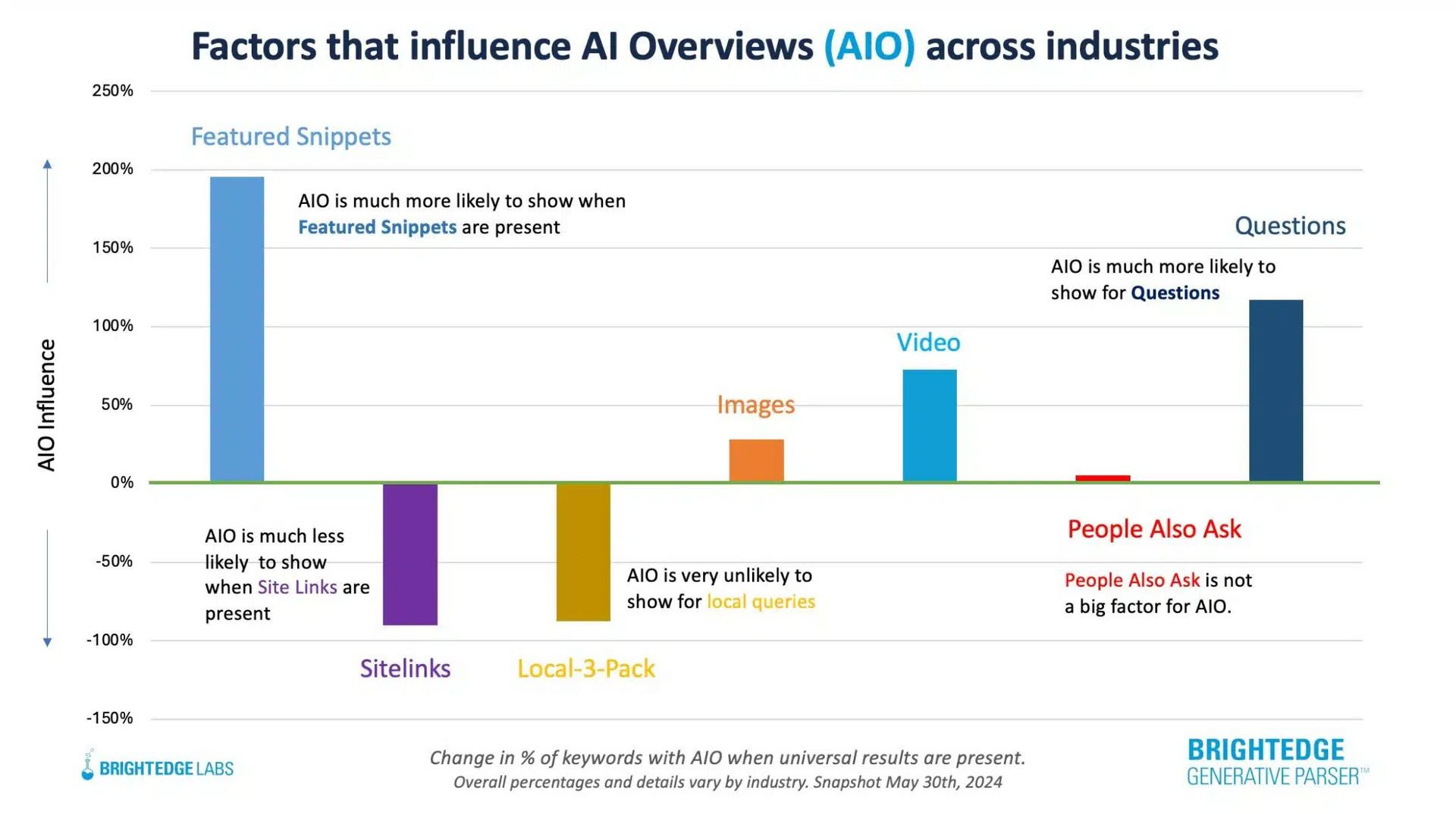
Chart source: BrightEdge Labs (Generative Parser). Shows how different SERP features correlate with the likelihood of AI Overviews appearing across industries.
That said, you can speed up the process with third-party AI Overview tracking. For example, SE Ranking’s AI Overviews tracking lets you monitor which keywords trigger AI snippets, whether your site is cited, which competitors are being featured, and how positions change over time.
You can also review the domains and URLs used as sources, assess authority signals like Domain Trust and referring domains, and map the intent behind AIO triggering queries.
In practice, you should focus on a small set of priority queries and:
- Test those queries regularly in Google’s SERP
- Monitor changes in organic position and CTR over time
- Check whether top-10 rankings are also earning AI Overview citations
- Record which paragraphs are being cited and reuse their structure across related pages
Studies have shown CTR can materially shift on queries that include AI Overviews,making citation presence increasingly tied to real traffic outcomes.
The key is consistency. AI Overview patterns tend to repeat once identified, and teams that log what works gain a compounding advantage.
Quick Wins to Try This Month
If you want to test AI Overview optimisation without large rewrites, start here:
- Reformat strong evergreen content into concise question-and-answer sections
- Add a small, evidence-based comparison table to priority pages
- Refresh pages already ranking 1–10 with a clear two-sentence summary at the top
- Link out to primary data sources wherever claims are made
- These updates often improve citation eligibility wit