Last week, I ran an experiment.
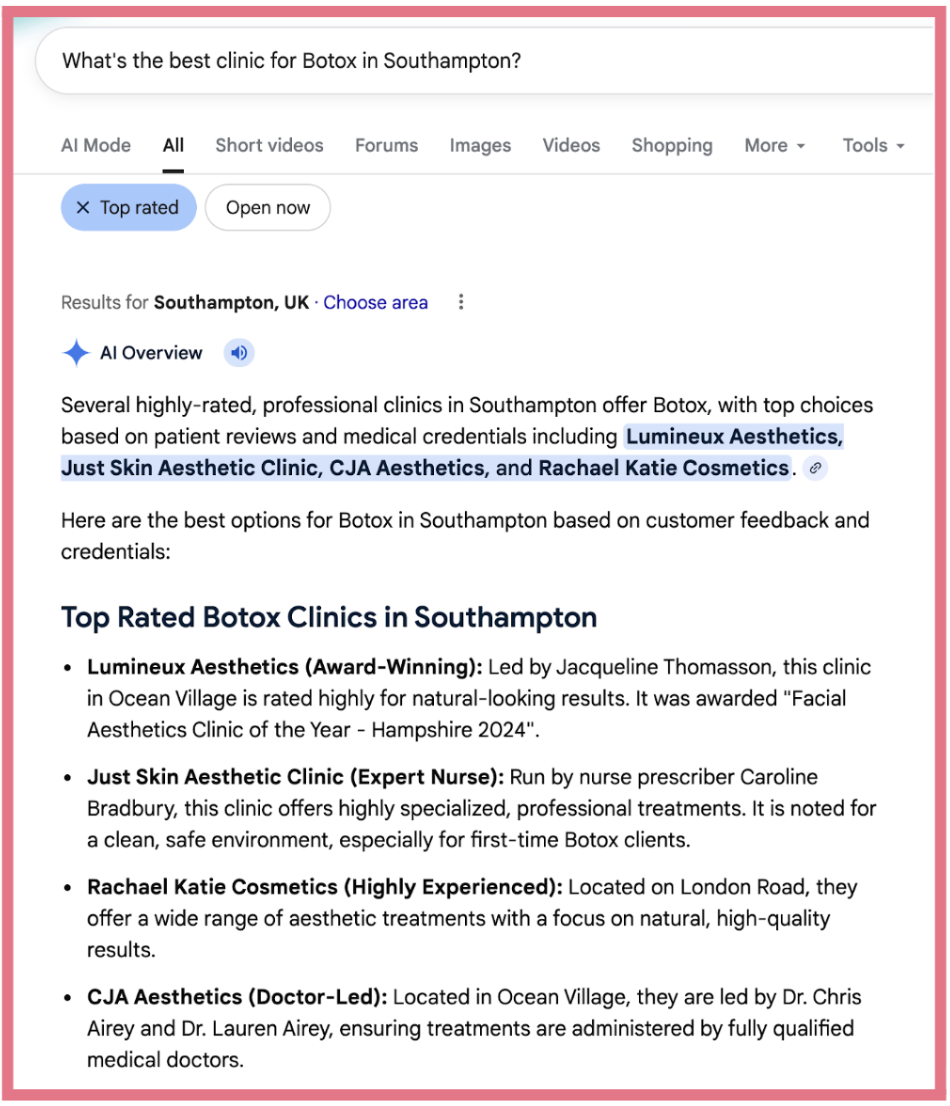
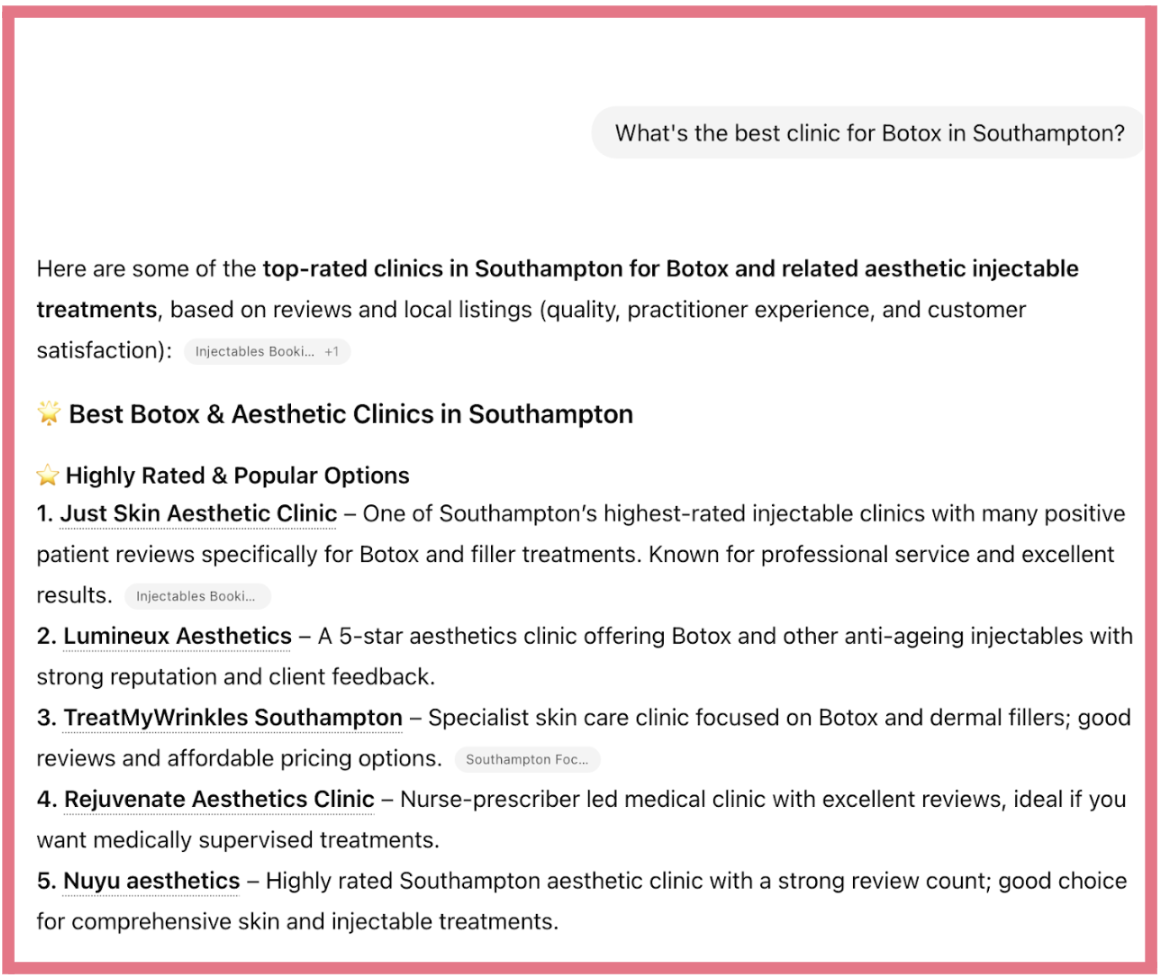
I opened ChatGPT and typed: What’s the best clinic for Botox in Southampton?
It gave me three recommendations. Confident, specific, with reasons why each one stood out.
Then I opened Google and searched the same thing. The top three organic results were completely different clinics.
Then I checked Google’s AIOverviews, the new AI-generated answer box that now loads above the traditional search results. Different again. A third set of clinic recommendations.
Three searches. Three different answers. Three different sets of clinics being put in front of potential patients.
We work with aesthetics clinics on their organic visibility, so I started testing how AI platforms recommend clinics compared to traditional Google results. What I found has changed how we think about search entirely, and if you run an aesthetics clinic, it should change how you think about it, too.
What I Actually Found
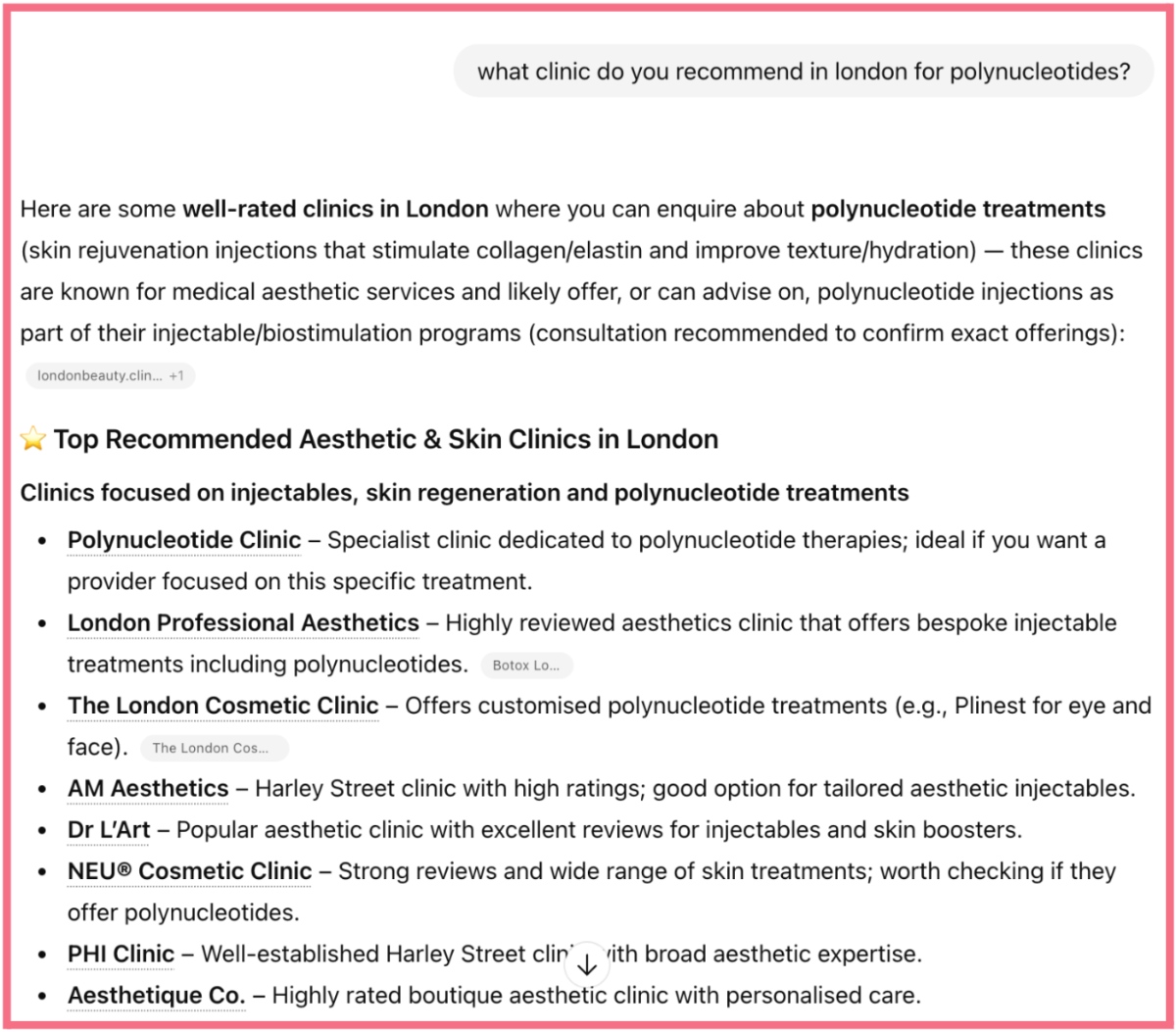
I ran this test across ChatGPT, Google AI Overviews, and Perplexity for a range of treatment searches in several UK cities. Searches like best lip filler clinic near me, where to get Profhilo in [city], and anti-wrinkle injections recommendations.
Across every city and every treatment I tested, the same pattern kept appearing. Sometimes there was overlap; clinics ranking well on Google also showed up in AI results.
But just as often, there wasn’t. Clinics sitting comfortably at #1 on Google were completely absent from ChatGPT’s recommendations, while competitors further down the page were being named first. A strong Google ranking helps (it usually correlates with having the right fundamentals), but it no longer guarantees that patients see you where they’re actually looking.
One clinic I looked at ranks #1 on Google for its primary treatment keyword in their city. That position reflects strong SEO and years of work. But when I asked ChatGPT the same question, the clinic wasn’t mentioned at all. Instead, ChatGPT’s first recommendation was a competitor ranking #4 on Google.
The difference? That competitor’s treatment page answers 14 common patient questions in detail. The #1 clinic’s page has 90 words and a price list.
ChatGPT blends information from across the web. It doesn’t just copy Google rankings. It favours clinics that have written in-depth treatment guides, published detailed FAQs, and built genuine authority through content that reads like a knowledgeable practitioner explaining a treatment, not a service listing with just a “book now” button.
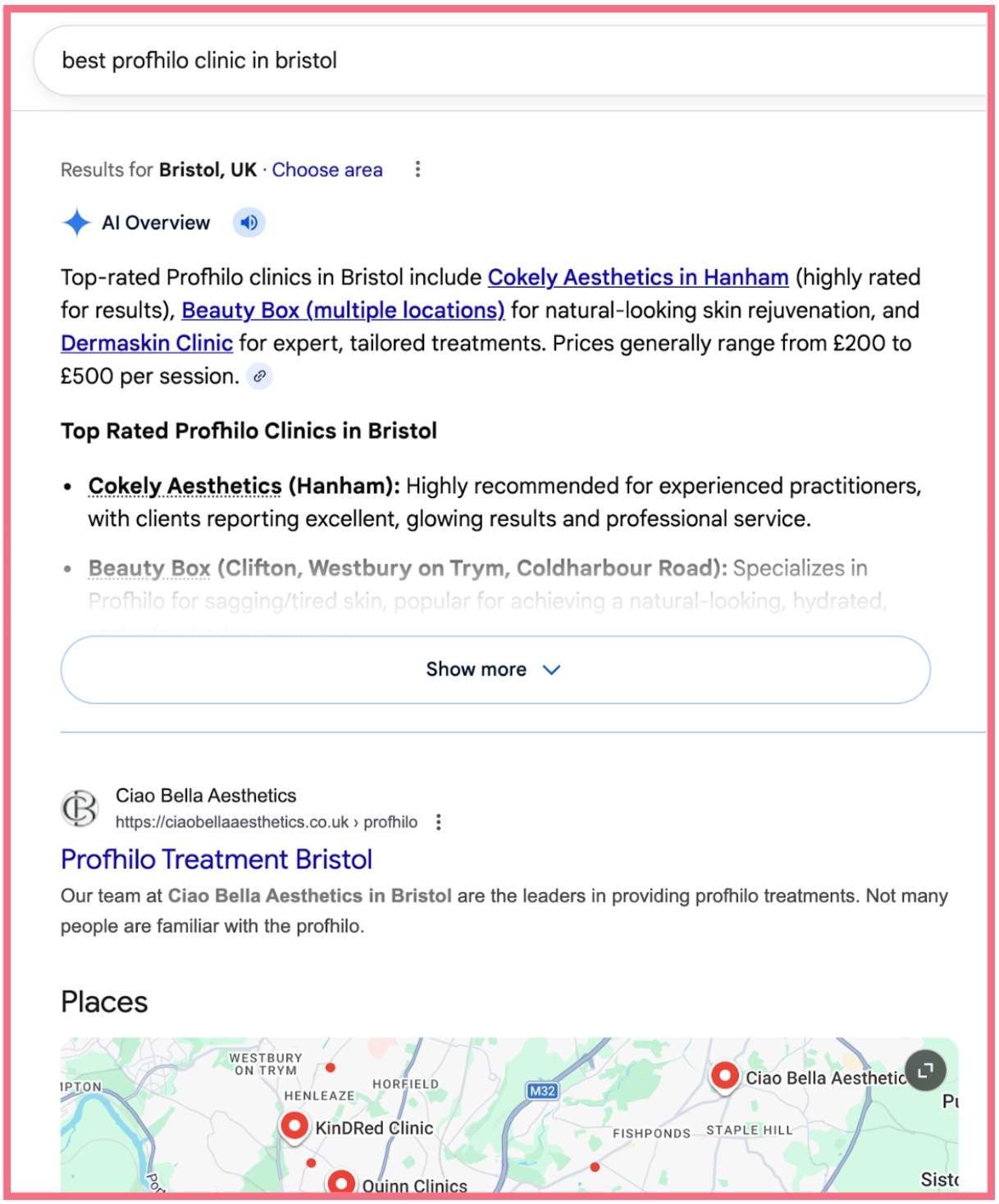
Google’s AIOverviews draws from a different set of signals again. It pulls from structured data on your website, your Google Business Profile, and content that directly answers the question being asked. According to research from BrightEdge, treatment and procedure queries now show AI Overviews 100% of the time – up from 45% in 2023. That’s a complete saturation of the treatment searches your patients are making.
Here’s the uncomfortable part: a clinic can rank #1 in the traditional blue links and still not appear in the AI Overview box sitting directly above them. The AI Overview is what patients see first. The #1 ranking is below the fold.
Perplexity is growing fast as a search alternative, processing over 780 million queries per month (Dataslayer), particularly among younger, research-driven patients, exactly the demographic booking aesthetic treatments. It cites its sources directly, meaning if your clinic’s website is referenced, you get both the recommendation and a visible, clickable link back to your site.
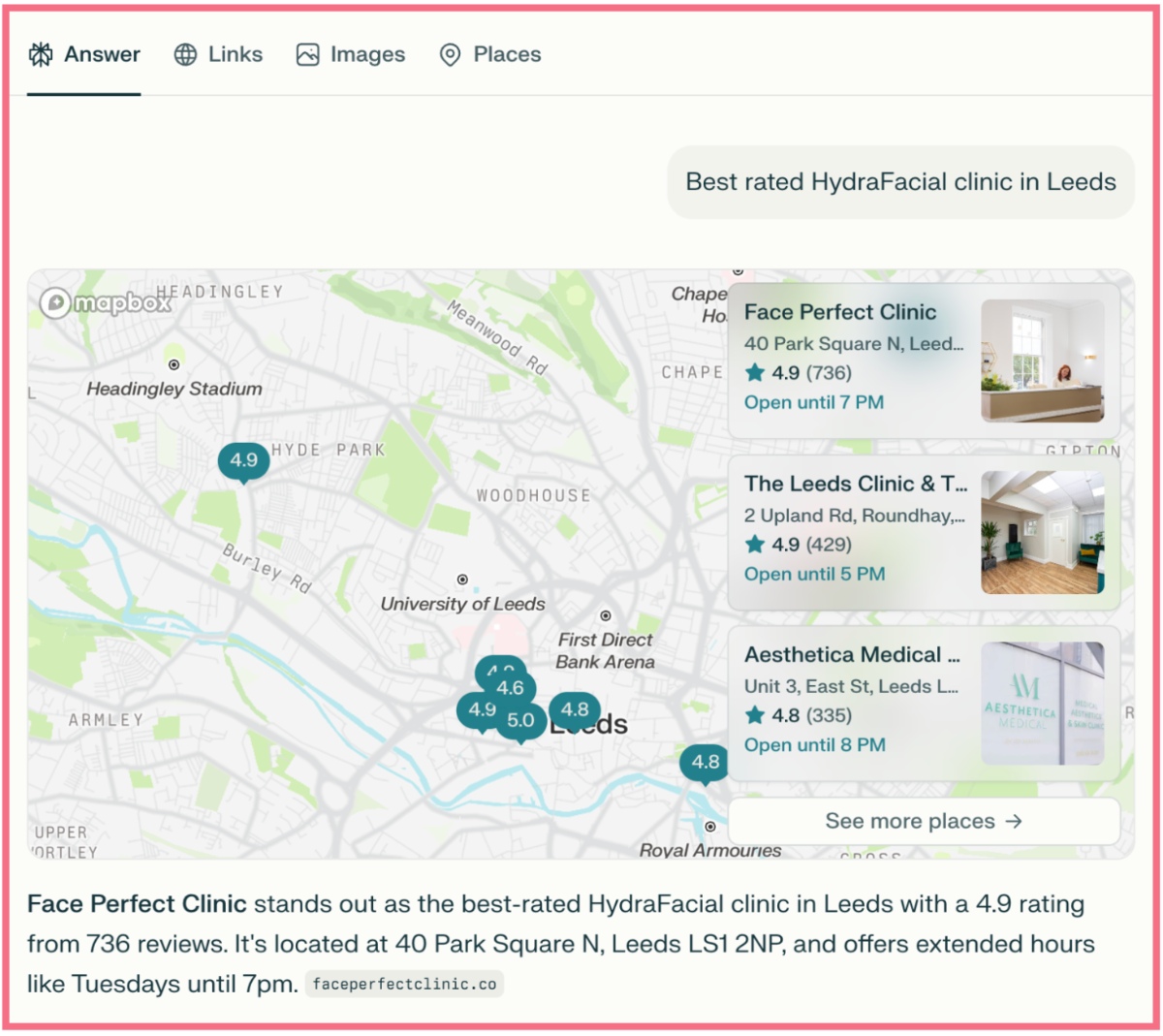
The clinics that were invisible across all three platforms had a common profile: thin service pages, no educational content, no structured FAQs, and little presence beyond their own website. That approach used to be enough. It isn’t anymore.
Why this Matters More than you Think
Here’s a simple test. Google your main treatment plus your location right now, something like “lip fillers Southampton” or “Botox Manchester.” Does an AI Overview box appear above the traditional results? For most aesthetic treatment searches, it does.
That AI-generated box is the first thing every potential patient sees. If your clinic isn’t cited in it, you’re invisible to anyone who doesn’t scroll past it. And more and more people don’t scroll.
Now multiply that across every treatment you offer, every variation of how patients search (best clinic for X, how much does X cost in Y, who does X near me), and every AI platform patients are now using alongside Google. The gap between clinics that appear in AI results and clinics that don’t is widening month by month.
Let’s put a number on it. If your clinic currently gets 50 new patient enquiries per month from online searches, and AI results are sitting above Google’s organic listings for the majority of your treatment keywords, which BrightEdge’s data confirms they are, a meaningful portion of those potential patients are seeing your competitors recommended before they ever see your name.
Even losing 10-15 enquiries per month to this shift, and based on what we’re seeing, that’s conservative, adds up fast. If your average first treatment sits between £180 and £300 (a typical range for injectables like anti-wrinkle and fillers), that’s £2,500 to £4,500 in immediate revenue walking past your door. And that’s just the first appointment.
Most aesthetic patients return every 3-6 months. A single lost patient isn’t a lost booking; it’s potentially thousands in lifetime value that went to whichever clinic the AI recommended instead.
Here’s the part that should really get your attention: patients trust AI recommendations in a similar way to how they trust a friend’s recommendation. It feels impartial. When ChatGPT says, “This clinic is known for natural-looking results and has strong patient reviews“, that carries more credibility than any ad you could run. You can’t buy that placement. You have to earn it.
“When ChatGPT recommends a clinic, it carries the weight of an impartial recommendation, not an ad. You can’t buy that placement. You have to earn it.”
What your Patients see When they Search for your Treatments
Before you read further, run these three tests. They’ll tell you more about your current visibility than any marketing report.
Test 1: Open ChatGPT and type: “What’s the best clinic for [your main treatment] in [your city]?” Are you mentioned? Are your competitors?
Test 2: Google your main treatment plus your location. Look at the AI Overview box at the top of the results, not the traditional blue links below it. Is your clinic cited in the AI answer?
Test 3: Go to Perplexity and search for “best aesthetics clinic in [your city].” Which clinics does it recommend? Does it link to your website?
If you appeared in all three, you’re ahead of 95% of clinics. If you didn’t appear in any, you now know exactly where the gap is.
If you’re a solo practitioner or running a small team, I know you don’t have someone monitoring this. You’re between patients, checking your phone at lunch, and this shift has happened without anyone flagging it. That’s partly why I’m writing this, because the clinics that need to know about it most are the ones least likely to have heard about it.
What Makes the Difference
I won’t pretend there’s a quick fix. This is a genuine discipline, called GEO, or Generative Engine Optimisation, and it requires a different approach from traditional SEO. It’s new enough that most marketing agencies, including those specialising in aesthetics, aren’t offering it yet. We’ve been working on it since Google started rolling AIOverviews across healthcare searches, because we could see this was going to reshape how patients find clinics.
But I can share what I’ve observed separates the clinics that appear in AI results from those that don’t.
The clinics that AI platforms consistently recommend have content that answers patient questions, not just describes services. Their treatment pages read like a consultation: what the treatment involves, who it’s suitable for, what to expect, how it compares to alternatives, what the aftercare looks like, and what the realistic outcomes are. They structure this information in a way that AI systems can extract, understand, and cite.
One concrete example: last month, we worked with a clinic whose dermal filler page consisted of a single short paragraph and a price list. After restructuring the page (using the same treatments, the same pricing, and without significantly increasing the amount of content), it began appearing in Google’s AI Overview for filler-related searches in their local area.
What changed wasn’t length, but structure. We introduced clear headings aligned with how real patients actually ask about treatments, applied technical markup that AI systems can reliably interpret, and language that sounds like a practitioner explaining, not a brochure selling.
That’s the shift. Your website needs to be readable by AI systems as well as human visitors. Right now, most clinic websites are only designed for the latter.
You already know you can’t run before/after photos in paid ads on Instagram. You can’t use “Botox” in Meta ad copy without getting flagged. Organic search has always been the workaround, the way clinics build sustainable visibility without being at the mercy of ad platform restrictions. But organic search itself has fundamentally changed, and most clinics are optimised for a version of Google that’s already being replaced.
Why the Clinics that Move Now will Win
The uncomfortable truth is that every month you’re not visible in AI results, your competitors, who are visible, are building authority that compounds. AI platforms learn which clinics to recommend based on repeated signals. The longer a competitor is cited across ChatGPT, Google AI, and Perplexity, the harder they become to displace.
It’s the same dynamic as traditional SEO; early movers build positions that latecomers struggle to overtake, but it’s accelerating faster.
Seer Interactive data backs this up: once a brand gets cited in AI Overviews, the benefit compounds – they earn 35% more organic clicks and 91% more paid clicks than competitors on the same queries. It’s a snowball effect for those who are visible and a vicious circle for those who aren’t.
Right now, in most UK cities, there are treatment searches where no local clinic is properly optimised for AI results. That’s an open goal. But the window is closing as more clinics and their agencies catch on.
The clinics that invest in AI visibility now will look back on this moment the same way clinics that invested in SEO five years ago look at their organic rankings today: as the decision that built their patient pipeline for years to come.
See Exactly where your Clinic Stands
I’ve been running these AI visibility tests for clinics across the UK, and the results are consistently eye-opening, even for clinics that have invested heavily in traditional SEO and paid ads.
If you want to see how your clinic appears (or doesn’t) across ChatGPT, Google AI, and Perplexity, we’ll run the full audit for you personally. No charge, no obligation.
Here’s what you’ll get:
- Screenshots of what patients see when they search for your treatments across all three AI platforms
- Competitor comparison, your visibility side-by-side with your top 3 local competitors
- Specific observations about where you’re visible, where you’re not, and what’s likely causing the gaps
- Honest assessment of your current position – no sales pitch, just the data
Or drop me an email at zach@sandbox-media.com with “AI Audit” in the subject line, and I’ll get it booked in.
Your patients are already searching differently. The only question is whether they find you, or your competitor.
Zach Havard is the founder of Sandbox Media, a digital growth agency specialising in SEO, Generative Engine Optimisation (GEO), and AI-powered growth systems for UK aesthetics clinics.