
Summarise this article with:
Last month, we published an audit of UK aesthetics AI visibility across ChatGPT, Perplexity, and Google AI Overviews. It established two findings that should reshape how clinics think about being found in 2026: AI platforms barely agree with each other on which clinics are best, and the depth of a clinic’s treatment-page content is the single strongest predictor of who gets mentioned.
This piece is about the layer those findings sit on top of. The platform a clinic’s website is actually built on.
We’ve spent the last month classifying the underlying tech stack of every clinic in our dataset. WordPress, Wix, Squarespace, Webflow, Shopify, Next.js and other headless setups, and the small but growing category of AI-built sites (Lovable, Bolt, v0, Durable, 10Web, B12). The goal was to answer a simple question: Does platform choice predict AI visibility outcomes, and if so, how?
The answer is yes, but not in the way you’d think. The platform doesn’t directly determine AI visibility. The platform determines whether a clinic can deliver the depth of content and structural signals that AI platforms actually reward. The platform is the scaffolding. The content is the building. Some scaffolds make the building easier to build; some make it a little bit harder.
This matters now because the platform layer is about to change. AI web builders are not yet a serious force (we found exactly one clinic on a pure AI builder in our sample), but they will gain ground in the next 24 months. The question is whether they will reshape the competitive landscape or land in the bottom tier. Our data points to the second answer.
How We Did This
The 161-clinic dataset is the same one from our April audit. Nine UK cities, six treatments, 314 clinic appearances total. The methodology and limitations from that piece apply here, too. Because our starting list was drawn from ChatGPT’s top 5 recommendations per query, the dataset is built from the competitive pool of UK aesthetics clinics that are already AI-visible, not the niche as a whole.
For platform classification, we used a combination of Wappalyzer-style fingerprinting against the live HTML of each clinic’s homepage, manual verification through tool inspection for ambiguous cases, and direct examination of the robots.txt file at each domain. Page builder identification (Gutenberg, Elementor, Divi, Oxygen, Avada/Fusion) was done by parsing the generator meta tag and looking for builder-specific class patterns in the rendered HTML.
The findings we report here are observations from a specific dataset at a specific point in time. AI platforms, web platforms, and clinic websites all evolve quickly. The patterns we surface should be read as evidence rather than as universal laws.
The Platform Breakdown
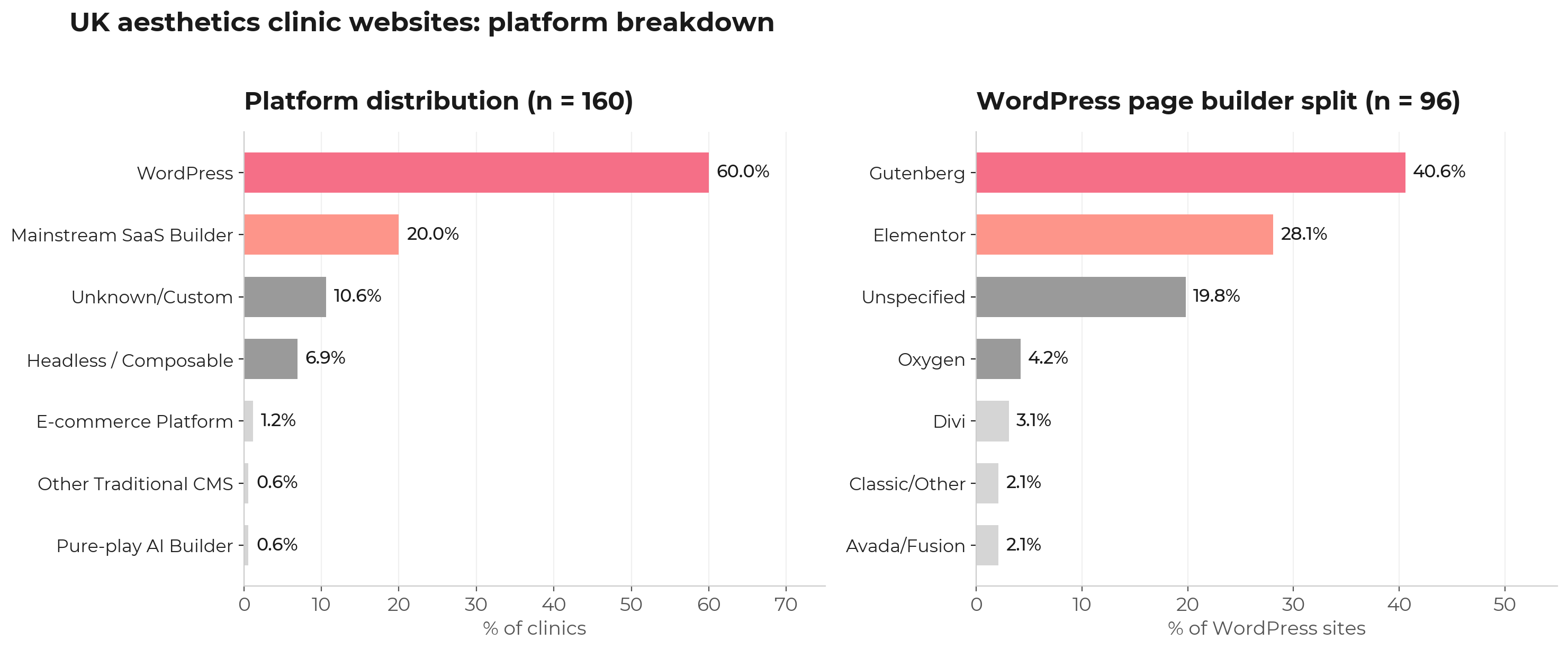
Of the 161 clinics in our sample, 60% are built on WordPress. That is significantly more concentrated than the open web (WordPress runs roughly 43% of all websites globally). UK aesthetics is a WordPress-heavy niche, more than most people realise.
The remaining 40% breaks down as follows:
- Mainstream SaaS builders (Wix, Squarespace, Webflow, HubSpot CMS): 20.0%
- Unknown or custom builds we couldn’t classify automatically: 10.6%
- Headless or composable stacks (Next.js, Nuxt.js, Storyblok front-ends, BigCommerce-on-Vercel): 6.9%
- E-commerce platforms (Shopify): 1.2%
- Other traditional CMS (Concrete CMS, Drupal-family): 0.6%
- Pure-play AI builders: 0.6% (one clinic, on 10Web)
Inside the WordPress majority, the page builder split was a genuine surprise. The conventional agency wisdom is that clinic sites are an Elementor-dominated category. Our data doesn’t support that. Gutenberg (the WordPress block editor) accounts for 40.6% of the classifiable WordPress sites. Elementor accounts for 28.1%. The other builders (Divi, Oxygen, Avada/Fusion, Beaver) make up the rest.
This is probably a recency effect. Newer clinic sites are launching on Gutenberg because that’s what modern WordPress themes default to. Elementor still dominates the established estate, but the trend line is clearly toward Gutenberg.
We saw no meaningful AI search performance difference between Gutenberg and Elementor sites in our dataset when content quality was held constant. The page builder choice is a developer-experience question, not an AI-visibility question. We’ll come back to why this matters when we look at AI builders later.
The Wix Structural Problem
This is the platform-layer finding most likely to be uncomfortable for the 20 clinics in our dataset on Wix.
Our April audit established that page quality is the dominant predictor of AI visibility. Strong content sites averaged 85% visibility across available AI platforms. Thin content sites averaged 66%. This finding doesn’t single out a platform, but the platform layer changes how easy it is to actually produce Strong content.
Wix has a specific structural issue here. Of the 36 query-observations across Wix-hosted clinics in our dataset, only one site (2.8%) had any form of meaningful schema implementation. By comparison, 58.9% of WordPress clinics had meaningful schema. The Wix native schema controls are limited, and full schema implementation usually requires third-party apps with monthly subscriptions or custom code injection. Most Wix-hosted clinic sites don’t do either.
Schema alone isn’t the issue (our April piece showed schema markup is not the lever some agencies have been selling it as), but the Wix limitation runs deeper. The platform’s editor is optimised for visual-first design, not for the kind of long-form, structured treatment-page content that maps cleanly for AI extraction. The path of least resistance on Wix is a short, image-led page. The path of least resistance on WordPress is a longer, text-led one. Multiply that across hundreds of clinics making thousands of small content decisions and the platform shapes the outcome.
When we look at the position data, Wix clinics in our sample reached ChatGPT’s top 3 in 36.4% of cases. The same number for WordPress was 59.3%. Squarespace 83.3%. Webflow 100% on a small sample. Wix is at the bottom of every platform-level position metric we can measure.
We are not arguing this is the fault of clinic owners on Wix. Most chose Wix because it offered a clean way to launch a site without a developer, and at the time that was the right call. The point is that the platform constraints have become a bigger issue as AI search has become more selective about the content it cites. A clinic on Wix in 2026 is not making a neutral platform choice. It’s starting the AI visibility race behind the line.
The lighter fix for Wix clinics: focus first on content depth. Use the Wix editor to produce the longest, most consultation-grade treatment pages you can, even if the design is less polished than you’d like. Add visible FAQ content (real questions, real answers, in plain text in the page body). Don’t waste budget on Wix-native schema apps until the content is right. If you’re growing past one location or five figures in revenue, start budgeting for a platform migration.
The Headless Paradox
Headless and composable stacks are technically the most sophisticated infrastructure in our dataset. Next.js on Vercel, Nuxt.js, Storyblok serving content over an API to a React front-end, BigCommerce providing commerce alongside content. Everything that traditional web performance and SEO benchmarks usually love.
Eleven of our 161 clinics are on headless setups. They include Therapie Clinic’s location pages (Next.js), Laser Clinics UK (Storyblok plus Next.js plus BigCommerce on Vercel, a properly modern composable stack), and several smaller chains and well-funded independents.
In our data, 81.8% of headless sites fall into the Thin content bucket from the April audit.
That is the inverse of what the infrastructure should be predicting. The most engineering-intensive platforms in the sample are also the ones most often shipped with thin treatment pages. The pattern is consistent enough that we want to give it a name: the headless paradox.
What appears to be happening is this. A clinic or chain invests in modern infrastructure, hires a development agency that delivers fast and well-designed pages with clean semantic HTML, and then fills those pages with whatever copy is to hand. The development budget covers the engineering. It rarely covers the editorial work to write Strong content at scale across dozens of locations and treatment pages. The result is a Ferrari running on the wrong fuel.
This dovetails with our April finding. Page quality is the dominant signal, and headless infrastructure doesn’t provide page quality. It provides the canvas on which page quality is either painted or not. The clinics getting the best results from headless investment are the ones who treated content as a first-class deliverable alongside the build. The ones who treated content as something to figure out after launch are sitting on expensive sites that AI platforms struggle to cite.
If you’re a clinic considering a headless build, the rule of thumb from our data: budget at least as much for the editorial work (treatment-page writing, FAQ content, ongoing content updates) as you do for the development. If you can’t, the cheaper WordPress build with strong content will likely outperform the expensive headless build with thin content.
AI Builders Are Almost Absent From This Niche Today
Across 161 clinics, we found exactly one running on a pure-play AI website builder. The site uses 10Web, which generates a WordPress site via an AI build process. Zero clinics in the sample are on Lovable, Bolt, v0, Durable, or B12.
For context on the AI builder landscape: Lovable, Bolt, and v0 are code-generation AI tools that produce React or Next.js codebases. Durable and B12 are template-driven AI tools that produce a working site from a prompt in minutes. 10Web sits between the two, building WordPress sites from AI generation. All five categories have grown rapidly in usage since 2024. None has meaningfully penetrated UK aesthetics yet.
The one 10Web site in our sample was unremarkable. It scored mid-table on AI visibility and mid-table on page quality. We don’t want to conclude on a single data point, but it sits closer to the median than to either tail.
The forward-looking question, and the one most clinic owners are actually interested in, is whether AI builder adoption will reshape the competitive landscape over the next 24 to 36 months. Our position, anchored in the platform-layer findings above, is that it won’t.
WordPress 7 and what “AI in WordPress” actually means
WordPress 7.0 launched on 20 May 2026, the week this piece was finalised. The release’s headline story is its native AI infrastructure: a unified AI Client in core, an Abilities API for plugins, and connectors that integrate WordPress directly with OpenAI, Anthropic, and Google Gemini.
This is sometimes described as WordPress “responding to AI builders,” which is not quite right. AI builders like Lovable and Bolt generate entire websites from a prompt. WordPress 7 adds AI assistance to the editing workflow inside a site that a human is still authoring. These are different categories of AI usage.
The distinction matters because the two approaches produce very different outcomes against the content-depth standard. AI builders generate commodity content because that’s what they were built to do. WordPress 7’s AI tools, alongside human input, can produce Strong content faster (less time fighting an empty page, more time refining the substance). Used carelessly, they produce the same commodity copy as anything else. The platform doesn’t decide; the user does.
For the 60% of UK aesthetics clinics already on WordPress, the upgrade adds optional AI assistance to a platform that already supports the content depth AI search rewards. For clinics on AI builders, the structural disadvantage doesn’t move.
Why AI Builders Will Land in the Bottom Tier
The argument here has three steps, each of which can be tested against the data we’ve already published.
Step one. Page quality is the dominant signal in AI search visibility. This is the headline finding from our April audit. Strong pages: 85% visibility, 69% perfect scores. Thin pages: 66% visibility, 36% perfect scores. The gap is large, consistent across all three AI platforms we tested, and shows up regardless of platform, builder, schema, or review volume.
Step two. AI builders, by design, produce content that maps to the Thin end of that spectrum. This is not a controversial claim once you’ve actually used the tools. AI builders are optimised for speed and consistency. They generate plausible, templated copy quickly. They can’t capture what a clinician actually sees in patient consultations because they were not in those consultations. They produce pages that pass the “is this readable” test but fail the test that matters: would a domain expert recognise this as written by a domain expert.
Google’s May 2026 AI Optimization Guide made this super clear. The primary criteria for whether a page is worth surfacing in AI Overviews and AI Mode is, in plain language: could this have been written by anyone, or generated by an LLM? If yes, the content gets devalued in AI search ranking. The guide is Google-specific in its phrasing, but the same principle is observable in ChatGPT’s and Perplexity’s behaviour. The platforms are increasingly trained to recognise commodity content and downweight it.
AI-generated content is commodity content by definition. It is the textbook case of what the guide is asking AI platforms to devalue.
Step three. The structural disadvantage doesn’t shrink as AI builders improve. This is the step most arguments about AI builders don’t realise. The intuition is that as Lovable, Bolt, and v0 improve, their output will improve and they will eventually produce content that competes with human-written content. We don’t think that’s how this plays out.
Here’s the dynamic. As AI builders get better and adoption grows, the volume of AI-generated content on the web increases. AI platforms see more commodity content, develop better criteria for identifying it, and devalue it more aggressively. The threshold for “Strong” content effectively rises, because what previously counted as adequate now reads as templated by comparison. The gap between AI-builder output and clinician-written content widens rather than closes.
This is the recursion problem people worry about with AI training. It applies in the opposite direction too. As AI search engines get better at spotting AI-generated content (and they’re explicitly being trained to do exactly this), the value of human, specific, first-hand content increases. The clinics who own that content asset get more visibility, not less.
The 24-month outcome we expect: AI builder adoption in UK aesthetics will grow, but it will concentrate in solo-operator clinics and rural clinics that don’t compete for AI search positioning anyway. The clinics currently winning AI visibility won’t migrate. They have no reason to give up the editorial investment that puts them at the top.
This is the kind of forecast that’s easy to make today and embarrassing to be wrong about in 2028. We’re committing to it anyway, with three specific predictions at the end of this piece.
The robots.txt Myth
This section sits slightly outside the platform layer, but it brings up another related agency narrative worth correcting with our data.
There has been a lot of industry chatter recently about clinics needing to either “open up their robots.txt to AI crawlers” or, on the opposite side, “block AI scraping to protect their content.” We tested the actual state of UK aesthetics robots.txt files by fetching and parsing /robots.txt on every clinic domain in our dataset.
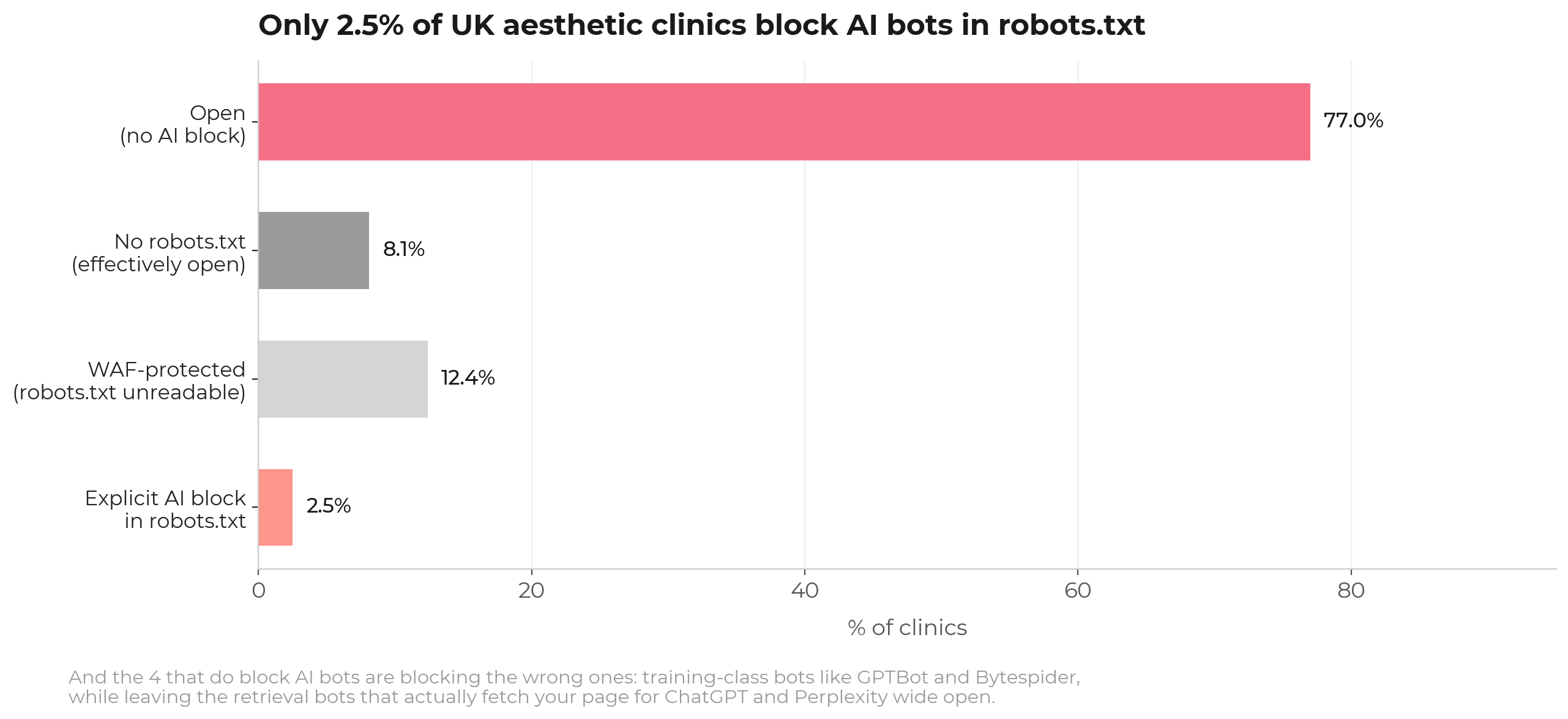
The numbers make most of the conversation irrelevant.
- 77% of clinics have a fully open robots.txt with no AI-bot rules at all.
- 8% have no robots.txt file (also effectively open).
- 12% are behind a Web Application Firewall that prevented us from reading robots.txt cleanly, almost all of them WordPress sites with Cloudflare or Wordfence configured.
- 2.5% (four clinics) explicitly block any AI bot in their robots.txt.
Of those four blocking clinics, every single one is blocking only training-class bots (GPTBot, Google-Extended, Applebot-Extended, Bytespider, CCBot). None of them block the retrieval-class bots that AI products actually use when a user asks ChatGPT or Perplexity about a clinic (ChatGPT-User, OAI-SearchBot, ClaudeBot, PerplexityBot, Perplexity-User, Amazonbot).
These two bot categories do completely different jobs. Training-class bots crawl your site to gather data for future model training. Blocking them does nothing to limit how your content surfaces in ChatGPT or Perplexity today. Retrieval-class bots fetch your page on demand when a user asks an AI product about you. Blocking those would actually affect current AI visibility, and nobody in our sample is doing that.
Three of the four blocking clinics use what appears to be the same copy-pasted bot list circulating in WordPress forums. They’ve blocked the wrong bots, by accident, while believing they were “blocking ChatGPT.” The performance numbers confirm the blocks are doing nothing. All four still appear in ChatGPT in 100% of relevant queries.
The headline: if you’ve been worried about your robots.txt configuration, you almost certainly don’t need to be. If you’ve pasted a “block AI” snippet from a forum, you’ve probably blocked the wrong thing, and it hasn’t hurt your AI visibility anyway. Spend the energy on content.
What This Means For Your Clinic
The actions depend on which platform you’re already on.
If you’re on WordPress (60% of clinics): Your platform is helping you, not hurting you. The path to AI visibility is the one our April piece described: invest in treatment-page depth, build a review acquisition system, add real FAQ content in plain text, fix findability gaps in your site structure. Don’t get distracted by schema-fixing services unless your content is already strong. Don’t get distracted by robots.txt audits unless someone has told you they pasted a block snippet.
If you’re on Wix, Squarespace, or another visual-first builder (20% of clinics): Content depth has to be your first investment, and the platform will fight you on it. Push the editor as far as it goes. Write long, structured treatment pages even if the layout is less polished than you’d like. Skip the schema apps until your content is right. Plan a platform migration once you’ve grown past the point where the limitations cost more than the move would.
If you’re on a headless setup (7% of clinics): Your developer has done their job. Your editorial work is the bottleneck. Budget for treatment-page writing the same way you budgeted for the build. Audit your existing pages against the Strong-page criteria from the April piece and rewrite the weakest ones first. The infrastructure is rewarding nothing if the content is thin.
If you’re considering an AI builder for a production clinic site: Don’t. They’re a false economy. The time you save in setup is paid back many times over in lost AI search positioning. AI builders are fine for marketing landing pages, rapid prototyping, or testing concepts. They are not a substitute for a properly written clinical website in 2026.
If you’re considering a platform migration: WordPress is the most defensible choice for most clinic sizes. The platform is mature, the talent pool is deep, the SEO and schema tooling is mature, and the ecosystem is large enough. Headless makes sense above a certain scale and budget, but only if you commit to the editorial work alongside.
Three Predictions For The Next Two Years
- By the end of 2027, no UK aesthetic clinic ranked in ChatGPT’s top three for a major treatment query (lip filler, Botox, BBL or HEROic, Profhilo, dermal filler dissolving, EMS body contouring) will be running on a pure-play AI-built site (Lovable, Bolt, v0, Durable, B12, 10Web, or their successors).
- Wix’s structural schema deficit and content-depth limitations will widen the gap between Wix-hosted clinics and WordPress-hosted clinics in AI Mode rankings by another 15 to 20% by mid-2028, barring a major change in Wix’s native content controls.
- AI builder adoption in UK aesthetics will pass 10% by mid-2027, but the share will concentrate in solo-operator and rural clinics, not the top 25% of clinics by revenue.
A Final Note
Our April piece argued that AI search results for UK aesthetics follow different rules from traditional Google search. This piece adds another layer to that. The platform a clinic chooses to build on is part of those rules. It shapes what content the clinic can produce, what structural signals the page can carry, and what scale of editorial work is even possible.
WordPress dominates UK aesthetics for a reason. It happens to be the platform that makes the right kind of content the easiest to produce. That’s not because WordPress is sophisticated. It’s because the platform stays out of the way and lets the clinician’s expertise become the asset.
The clinics that will win AI visibility over the next 24 months are the ones whose platform supports them. The clinics that will lose are the ones whose platform quietly works against them, while they invest in everything except the thing that actually moves the needle.
The platform layer matters. It just doesn’t matter in the way most of the conversation has assumed.
Want to See Where You Stand?
Following the response to our April audit, we’re running another round of free AI visibility audits for selected UK aesthetic clinics. This time we’re also assessing the platform layer: what your site is built on, what limits the platform places on your AI visibility, and the highest-leverage actions to fix the gaps.
If you’d like us to audit your clinic across ChatGPT, Perplexity, and Google AI Overview, plus a platform-layer assessment and a treatment-page review using the same methodology described in this piece, send us a message. We’ll send a written report showing exactly where you appear, where you don’t, and what’s blocking you.
Request your Free AI Visibility Audit
No sales pitch, no obligation. We’re using these audits to expand our dataset for the next piece of research, and we think the findings will be useful to you whether or not you decide to work with us.